
Opening the morning paper recently, a quarter-page Reserve Bank of India (RBI) advertisement caught the attention.
The message was clean and simple: "Cash, but Digital!"
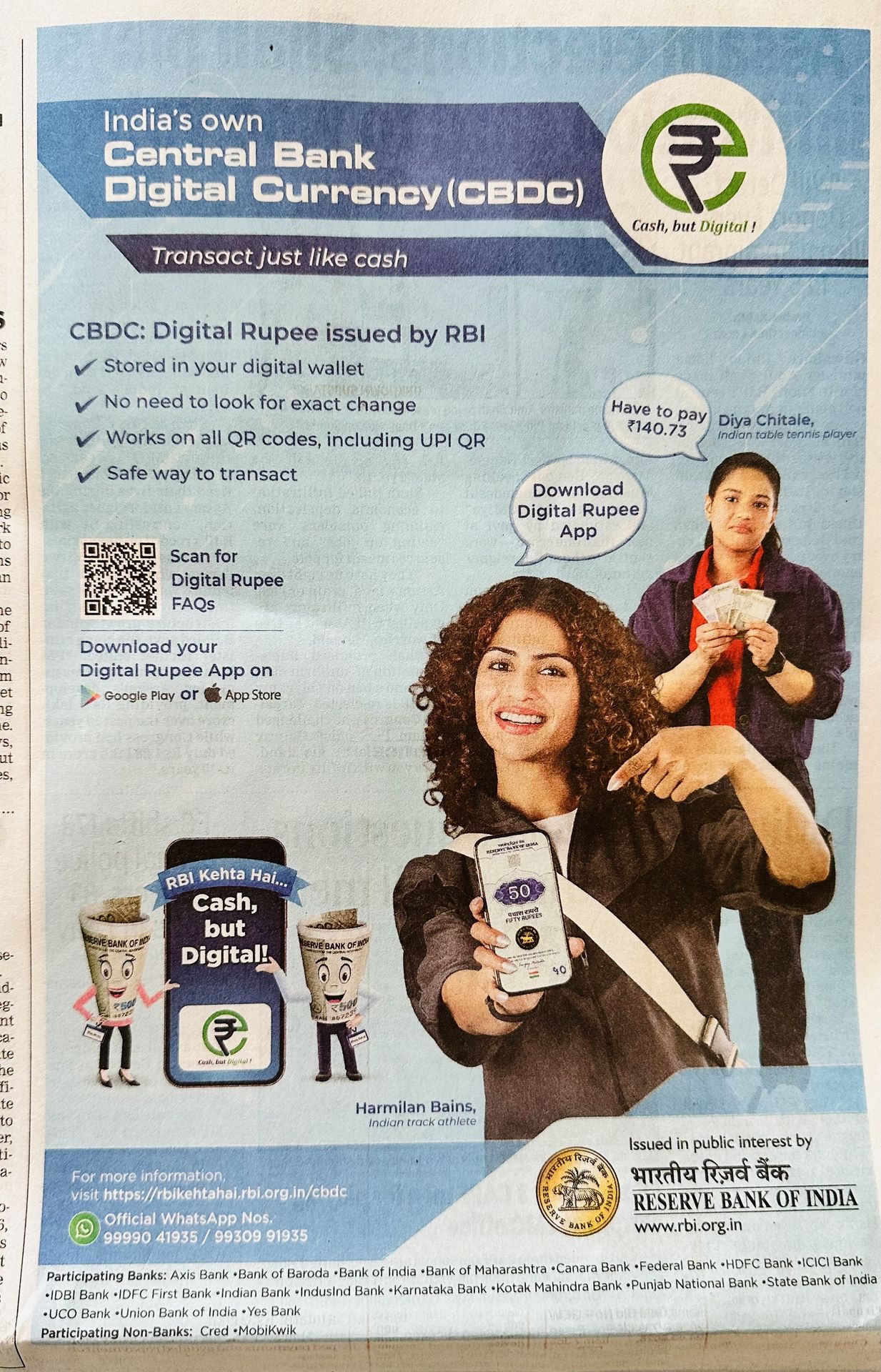
India is already a global titan of digital payments. In 2022 alone, the country registered a staggering ₹149.5 trillion in UPI and card transactions. With the Unified Payments Interface (UPI) already serving as the lifeblood of our daily commerce, the RBI’s aggressive pilot of the Central Bank Digital Currency (CBDC)—the Digital Rupee (e₹)—naturally sparks a massive question:
Why do we need a digital fiat currency when our current digital payment systems work flawlessly?
To answer this, we need to look beyond the surface of a simple transaction and examine the very architecture of money. Here is the ultimate, all-encompassing guide to understanding the Digital Rupee, how it diverges from UPI, and how it will rewrite the rules of global trade, corporate finance, and retail consumption over the next decade.
Architecture and Core Concepts
What exactly is the Digital Rupee (e₹)?
A: The Digital Rupee (e₹) is India's Central Bank Digital Currency (CBDC). It is the digital equivalent of India's physical fiat currency. Issued directly by the RBI, it is a sovereign liability and is recognized as legal tender under Section 26 of the RBI Act, 1934. It is available in the exact same fixed denominations as physical cash (e.g., ₹100, ₹500), which helps build consumer trust and familiarity.
Q: Will I have an account directly with the RBI?
A: No. The RBI has adopted an Indirect (Two-Tier) Model to prevent systemic disruption.
Tier 1 (The Central Bank): The RBI is responsible for minting, issuing, and destroying the digital tokens via a core ledger based on Distributed Ledger Technology (DLT) or Hyperledger Fabric.
Tier 2 (The Intermediaries): Commercial banks (like SBI, HDFC, ICICI, etc.) handle the distribution, user onboarding (e-KYC), wallet management, and customer service through an API-based non-DLT infrastructure.
Q: What is the difference between Retail CBDC (e₹-R) and Wholesale CBDC (e₹-W)?
A: The RBI has intelligently bifurcated the digital currency based on the end-user:
Retail CBDC (e₹-R): Intended for the general public and businesses for everyday transactions. It is a Token-based system, meaning it functions like a digital bearer instrument—whoever holds the token in their wallet owns the value.
Wholesale CBDC (e₹-W): Restricted to financial institutions. It is an Account-based system used specifically to streamline interbank settlements, clearing, and large-value institutional transactions.
The Great Debate – CBDC vs. UPI
Isn't CBDC just UPI with a different name?
This is the most prevalent misconception. They are fundamentally different at an architectural level:
UPI is a Payment Rail: It is a messaging interface that instructs your commercial bank to move money to another bank. The transaction settles on a deferred net basis between banks, and the liability lies with the commercial banks.
CBDC is Actual Money: It is a sovereign asset. When you pay a merchant via a CBDC wallet, the digital token leaves your wallet and enters theirs instantaneously. There is no intermediary bank routing or delayed interbank settlement because you are handing over a digital cash bearer instrument.
Will my e₹ wallet pay me interest like my savings account?
No. The Digital Rupee is strictly non-remunerated (no interest). This is a critical macroeconomic design choice. If CBDCs paid interest, millions of citizens would shift their funds from commercial bank deposits into risk-free RBI wallets. This "deposit flight" would severely cripple the banking sector's ability to lend money, inevitably driving up loan interest rates and disrupting monetary policy transmission.
Physical cash is anonymous. Is the Digital Rupee anonymous?
A: Absolute anonymity in a digital realm is impossible due to digital trails and the need to combat money laundering. However, the e₹ operates on a principle of "Managed Anonymity". For small-value transactions (currently under ₹50,000), transactions between wallets are completely anonymous and are not recorded in your bank statements, perfectly mimicking the privacy of physical cash. High-value transactions, however, remain traceable to satisfy Anti-Money Laundering (AML) and Combating the Financing of Terrorism (CFT) compliance.
The Macro Motivations – Why Do We Need It?
If UPI is so successful, why undergo this massive systemic shift?
The government's motivations extend far beyond everyday consumer convenience:
The Astronomical Cost of Cash: Managing physical cash is a logistical nightmare. In the 2021-22 fiscal year alone, the RBI spent ₹4,984.80 crore just on printing currency. A single ₹100 note consumes 15% to 17% of its total value in operational costs over a four-year lifecycle. CBDC heavily reduces these costs and slashes the carbon footprint associated with cash logistics.
Financial Inclusion: India’s Financial Inclusion Index stood at 56.4% in March 2022. A CBDC wallet does not strictly require a traditional, fully functional bank account, lowering the barrier to entry for the unbanked population.
Neutralizing the Crypto Threat: Private cryptocurrencies challenge the fundamental notion of sovereign money. They cause macroeconomic instability and diminish the central bank's control over monetary policy. The e₹ provides the public with a safe, legitimate digital asset without the volatility of private crypto.
Systemic Resilience: Relying entirely on existing payment rails concentrates risk. CBDC offers an independent, parallel payment infrastructure, ensuring the economy keeps moving even if commercial banking networks face technical outages.
The 5-to-10 Year Horizon: Transformative Use Cases
While the current retail pilot focuses on smooth onboarding and interoperability—allowing users to scan existing UPI QRs to pay via their CBDC wallets —the true power of the Digital Rupee will unfold over the next decade.
The Power of Programmable Money
CBDCs support "smart contracts," allowing money to be programmed for specific, predefined uses.
Government Subsidies (DBT): Agricultural credit can be programmed so the tokens are only valid at registered fertilizer or seed outlets, eliminating fund diversion.
Corporate & Franchise Operations: Consider a centralized raw material ordering system for franchise stores. A parent brand could distribute programmed e₹ to franchisees that can exclusively be spent at approved wholesale suppliers. This ensures absolute compliance with supply chain protocols and automates complex reconciliation processes.
Unlocking Offline Digital Payments
UPI’s greatest vulnerability is its dependency on internet connectivity. The RBI is actively exploring solutions—including NFC, Bluetooth, and secure hardware chips—that will allow offline device-to-device transfers. Whether you are in a remote Himalayan village or an underground metro tunnel, you will be able to simply "tap and transfer" digital cash without telecom network availability.
Wholesale CBDC: Revolutionizing Capital Markets
The e₹-W pilot is currently live for settling secondary market transactions in Government Securities (G-Secs), the call money market, and tokenized Certificates of Deposit. By using central bank money for settlement, institutions bypass the need for clearing corporations or collateral, reducing settlement times and operational costs to near zero.
Frictionless Cross-Border Trade & Remittances
India received over $89 billion in inward remittances in FY22. Currently, cross-border payments rely on the sluggish and expensive SWIFT network and correspondent banking. Through international collaborations—like the BIS Innovation Hub's Project mBridge and Project Dunbar—interoperable CBDC ledgers will soon allow expats and global businesses to execute cross-border settlements in real-time, 24/7, bypassing traditional forex frictions. In a geopolitical landscape where BRICS nations are exploring de-dollarization, the Digital Rupee positions India as a leader in next-generation global trade infrastructure.
The Bottom Line: Overcoming the Hurdles
The transition will not be without challenges. The RBI must continuously balance privacy with AML regulations , scale the Distributed Ledger Technology to handle billions of daily micro-transactions , and provide a compelling incentive for consumers to adopt the e-wallet alongside their favorite UPI apps.
However, the trajectory is clear. UPI taught India how to pay digitally; the Digital Rupee is redefining what we are paying with. The e₹ is not here to cannibalize existing digital payments. It is here to upgrade India’s financial plumbing, creating a programmable, resilient, and borderless economy for the decades to come.
*** For further reading and official guidelines, visit the RBI's Official CBDC Portaland review the Concept Note on Central Bank Digital Currency.